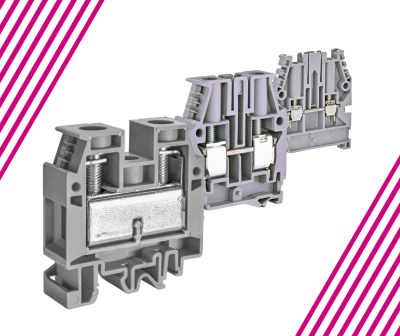
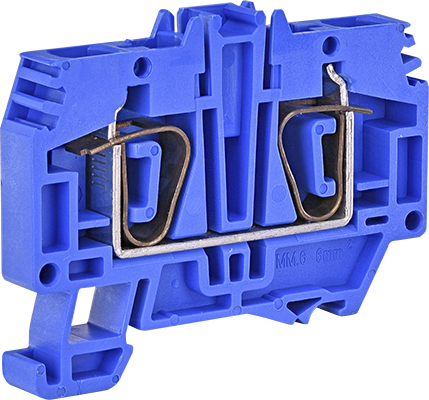
ETI product series
Aluminum conductors oxidize quickly once stripped, and the resulting oxide layer is a poor conductor, so terminations must be prepared carefully.
ETI recommends:
(1) brush off oxide;
(2) coat the cleaned strand in neutral Vaseline and clamp immediately to the specified torque, repeating the process each time the cable is re-connected;
(3) install only in dry, non-aggressive environments;
(4) re-check torque after a few days;
(5) fit ferrules on conductors larger than 25 mm².
Because aluminum’s resistivity (0.0284 µΩ m) is about 60 % higher than copper’s (0.0178 µΩ m), an Al cable of the same cross-section carries less current and therefore does not impose greater thermal stress on the terminal clamp—the key is maintaining a clean, gas-tight mechanical joint.
ETI’s ESC-SCB series combines circuit isolation and measurement in a single, DIN-rail module. A removable conducting element in the lever lets you slide the link open, instantly disconnecting the line for testing or safety. Adjacent blocks can be commoned with a simple “parallel skid” that screws in once the side wall is trimmed, giving rapid multi-pole bussing. Every model clips onto PR/DIN G32 or TH 35 rails in line with IEC 60715, is moulded in grey, and withstands ambient temperatures up to 100 °C.
Three configurations cover most test-bay needs. The basic ESC-SCB.6 is a straight disconnect block. The ESC-SCB.6/DD adds test-plug sockets on both sides of the link and meets ENEL LV 27/3. For fault-finding loops, the ESC-SCB.6/CD provides an upstream test socket and a downstream short-circuit sleeve (types PO-2 or PO-4) compliant with ENEL LV 27/2.